Friday, 20 May 2011

Long overdue AMNH visit!


Oh how time disappears quicker than a rat down a drain-pipe...It seems only last week that I was promising images of the American Museum of Natural History )New York), but failed miserably at getting back to my blog...until now!

Just entering the museum provides you with a stunning dino-tastic diorama...and that's before you even have to part with any money! If you get a chance...just stand underneath this vast animal and look straight up. Some dinosaurs were not just big, they were huge...
The dinosaur galleries are something to behold and have long been a favorite of mine. This is where I shall pictorially take you now.
The dinosaurs are divided into two main halls, one saurischian and the other ornithischian...lets start with our friends the lizard hipped beasties.
Here Apatosaurus ambles along in some Paluxy River (Texas) sauropod tracks....quite apt! Opposite is a theropod...
...possibly my favorite large predator from the Jurassic...which always leaves room for the skull and skeletal mount of possibly the most famous, or should I say infamous, predatory dinosaur in the world.....
...yup, Tyrannosaurus rex. This is the skull that we all want to see....well, almost! I have to admit there are other stunning predatory dinosaur fossils in this exhibition, some who lack in size, make-up on tooth count to cause major trauma...such as my favorite small theropod, Deinonychus.
However, before I depart on a Cretaceous note, why not end on a rather important predator from the Triassic of Ghost Ranch (New Mexico). A great location name, filled with beautiful fossils of one of the earliest predatory dinosaurs, Coelophysis...
Last and certainly not least...we must not forget the strange theropods from Mongolia, no...not Velocirapter, as they are not that strange at all, but jumping beak-first into the theropod (I forgot my teeth) strangeness awards, is Oviraptor...
...perched, or should I say 'nesting' on a clutch of eggs. This mis-named dinosaur, mistaken for an egg-thief, should have been named 'Ovimaiasaura'...the 'egg-good-mother' dinosaur!

It would be unfair to show you all the saurischian dinosaurs at the AMNH, as you HAVE to visit there if you ever find yourself in New York City. Now...that is enough tooth (toothless) and claw for one day. Tomorrow (I hope) I will take you to the land of bird-hipped dinosaurs, the ornithischians at the AMNH.

Wednesday, 27 April 2011

Caught between continents!

My blogging has fallen by the wayside these past few weeks. The day after my visit to the AMNH I had to dart over to the UK to put a Gobi dinosaur vertebra on the X-Ray CT spit, then jump on a plane to Germany to give a paper at a wonderful meeting in Obernkirchen. I then had to hop back on a plane to the UK, via Zurich...spending a night writing-up a paper with a colleague in Manchester, before heading back to the USA the next day...and that's when I started getting busy!

Close Encounters of a Saurian Kind....A night a the Obernkirchen Dinosaur Track Site in Lowe Saxony.


I realize that I have a great deal of blogging to catch-up with...I shall endeavor to do this at the weekend....now let me think, what day is it today?

Friday, 8 April 2011

A day at the Museum.....

I find myself sat in a coffee shop, en-route to New York City...realizing that I have not written my blog for a couple of weeks! The wonder of free WiFi comes to my rescue. To be honest, I have been buried with work these past few days...yes, the usual. Reviewing and writing papers, teaching and also completing my BLM permit application for this summers excavation in the Hell Creek Formation (South Dakota). As always, life is never dull, just busy.

So, why New York? That's easy to answer, as located there is one of the museological gems of the world, The American Museum of Natural History (AMNH). I shall not be alone on this pilgrimage, as I have a group of undergraduate and graduate students from the University of Pennsylvania along with me. They too share my enthusiasm for this historic institution and its incredible collections. No less than the first Tyrannosaurus rex arrived here in the first gasp of the 20th Century. The then assistant curator, Barnum Brown, excavated this 'Coca Cola' of dinosaur brands into the world, but his boss Henry Fairfield Osborne was responsible for naming it in 1905. Thankfully, the name has stood the test of time, unlike the unfortunate case of Brontosaurus...a long 'tail' I must recount at some point.

The AMNH became even more famous, if that were possible, after the release of the film, 'A Night at the Museum'...a splendid tale of bones that go bump in the night. The said film was set in the hallowed halls of the AMNH, with its impressive outlook on Central Park. However, when visitors first make their way up those famous museum steps and in through the grand front entrance off Central Park...they are met with a very different museum from that seen in the Film. This is simply because all the interior shots for the said film were shot elsewhere on an artificial set....you cannot blame the AMNH for this. Imagine the chaos of filming a Hollywood movie inside one of the most popular visitor attractions in New York. Impossible!

Tomorrow, I shall endeavor to take you on a pictorial tour of my 'Day at the Museum'.

Thursday, 24 March 2011

50 Million year old Reptile skin....splendid!

Today the University of Manchester Palaeontology Research Group  published another paper in the journal Royal Society Proceedings B. The subject of this paper, some beautifully preserved reptile skin. The brightly-coloured image below shows the presence of amide groups – these are organic compounds (building blocks of life) – in the ancient skin of a fossil reptile, found in the 50 million year-old rocks of the Green River Formation in Utah, USA.


This image had never been seen by the human eye, until our team, in this case led by Dr Roy Wogelius and graduate student Nick Edwards, used state-of-the-art infra-red technology to reveal and map the fossilized soft tissue from this beautifully-preserved reptile.

These infra-red maps are backed up by the first ever element-specific maps of organic material in fossil skin generated using X-rays at the Stanford synchrotron in the USA, working in collaboration with Dr Uwe Bergmann at SLAC. This is the same technology that was used to hed light on the chemical ghost of feathers preserved in Archaeopteryx, published again by our team last year in PNAS.

Chemical details are clear enough that we able to propose how this exceptional preservation occurs. When the original compounds in the skin begin to break down they form chemical bonds with trace metals, and under exceptional conditions these trace metals act like a ‘bridge’ to minerals in the sediments. This protects the skin material from being washed away or decomposing further...literally a fossiliferous hard-hat!

Roy is as chuffed as ever about the results, saying, “The mapped distributions of organic compounds and trace metals in 50 million year old skin look so much like maps we’ve made of modern lizard skin as a check on our work, it is sometimes hard to tell which is the fossil and which is fresh.”

Roy is also keen to point out to the palaeontological community that, “These new infra-red and X-ray methods reveal intricate chemical patterns that have been overlooked by traditional methods for decades.”

The new images are compelling, and represent the next step in our research programme to use modern analytical chemistry and 21st century techniques to understand how such remarkable preservation occurs, and work towards discovering more on the fossil chemistry preserved in ancient life.

These new results imply that trace metal inventories and patterns in ancient reptile skin, even after fossilisation, can indeed be compared to modern reptiles. The infra-red light causes sweet vibrations in the fossilized skin, and a map of where these vibrations occur can be obtained from a fossil by using a trick: a tiny crystal (like an old phonograph record stylus) which moves from point-to-point in a programmable grid across the surface.

At each point where the tiny crystal touches the fossil, an infra-red beam that shines through the crystal reflects off of the crystal base, but a small amount of the beam probes beyond the interface- and if organic compounds are present, they absorb portions of the beam and change the reflected signal.

This has allowed our team to non-destructively map large fossils which do not themselves transmit or reflect the beam – a revolutionary process for paleontologists.

Nick Edwards, first author on the publication, said: “The ability to chemically analyse rare and precious fossils such as these without the need to remove material and destroy them is an important and long overdue addition to field of palaeontology.

Here physics, palaeontology and chemistry have collided to yield incredible insight to the building blocks of fossilized soft tissue. The results of this study have wider implications, such as understanding what happens to buried wastes over long periods of time. The fossil record provides us with a long-running experiment, from which we can learn in order to help resolve current problems.


You can learn more about this discover on a video podcast with myself and Roy! Just click HERE

Tuesday, 15 March 2011

...that's funny?

Last week was fun. In a fossil-kind of way...where I had time to sit down and talk with colleagues from across the many departments and faculties at Manchester who make-up the Palaeontology Research Group. From Mike Buckley with his protenacious approach to palaeo, Bill Sellers bounding forward with his locomotion work, Bart van Dongen blasting organic molecules into revealing their identities with his thermal hammer (Pyrolysis unit!) and Roy Wogelius burying his head into surficial processes at the atomic level on squished animals now entombed in rock....precious fossils. I also managed a quick dash to Paul Mummery's x-ray CT emporium, but alas he was off to Oxford with my palaeo-computational colleague Lee Margetts. All these folks and more make-up the unique, some say quirky, group that is the University of Manchester Palaeontology Research Group.


As I have said in prior postings, it is this cross-faculty, multidisciplinary nature of our group that has been the secret to our success. We have all found common ground in long dead beasties...or 'fossils', as some prefer. The most important aspect of this group for me, is what I have learnt from these diverse disciplines, changing the way I conduct, collaborate and manage my research. The fact that I am now happy to talk about the interaction of intense monochromatic synchrotron x-rays with the electronic orbitals of atoms and the associated x-ray induced K-L shell transitions of electrons in fossils,...has simply reinforced how important collaboration is with scientists from outside my discipline. I feel privileged that my knowledge has significantly broadened, but at the same time my understanding has deepened. This is a function of both patient and good colleagues. 


Isaac Asimov, a brilliant (possibly the greatest) science fiction writer and an excellent scientist to-boot, once said, 'The most exciting phrase to hear in science, the one that heralds new discoveries, is not 'Eureka!' but 'That's funny...'


It great working with a group of scientists that at almost every twist and turn in our research we meet curious results that engender a similar Asimovian response. However, the key in our group is having the broad expertise to follow-up with sensible hypotheses that can then be tested and validated, before we go public on those 'funny' moments.

Friday, 4 March 2011

Dear Diary......

On Sunday night I head to Manchester. Once again I face the gauntlet of airline seats so vast that a garden gnome would feel claustrophobic, this combined with an atmosphere so thick that a very sharp knife would be required to even dent the said fuselage smog. The mere thought of airline food has me reaching for my supply of melatonin in the vain hope I will sleep through the optimistic nudge from flight staff asking that I partake in there wares. At times like this, I recall a French PhD student's comment while on fieldwork in the UK. I asked him his view of British Cuisine, his thoughtful reply was, 'Phillipe, this is not cuisine; this is food'...this makes my airline food by comparison look protenacious at best. If....a large 'IF' underlined in bold ink, with large flashing lights...I manage to nod off to sleep, I always end-up precisely folded into my available space like a piece of well-packed, pre-assembly Ikea furniture. The uncomfortable 1 or 2 hours of sleep (at best) is always broken by the announcement of our impending arrival to UK shores...an unhelpful one hour in advance of landing...I beg airlines to let us economy class folks sleep till 10 minutes before we start our descent, in the same way that they allow business class passengers! I was not aware that the upgrade correlated with how much sleep you were allowed on a long-haul flight. I often look enviously at the light blue drapes that lead through to the peaceful world of business class, where the dim-lit cabin affords its occupants those precious extra minutes of slumber.

As soon as we hit the tarmac at Manchester Airport, it's off to the University of Manchester to work through my haze of jet-lag. I'm sure that the US military sleep-depravation exercises did not feel this bad. My schedule next week is complex...I say 'schedule' now, given each time I asked a US colleague to share their diary with me, this was met with a frightened expression, often with rapid recognition that another 'British-ism' had crossed their path. A diary is a very private 'dear diary' kind of place in the USA...and is nothing to do with a schedule... pronounced 'sked-duel'. I tried arguing that this was pronounced incorrectly and should always be a 'shed-duel'....this is usually met with disdain and the follow-up of 'So, which 'shool' did you attend to learn English?'. My reply to that is, 'In an English 'shool' in Wells, England...where they taught me to speak English'. Churchill was right, we are 'two countries divided by a common language'.

However, back to my diary! The week will be driven by working through a PhD thesis recently sent to me to proof-read by one of the graduate students I co-supervise at Manchester. This will be punctuated with many meetings, the CT scan of a Gobi dinosaur's twisted vertebra, pyrolysis gas-chromatography mass spectrometry of some dinosaur fossils and a podcast. The latter is with a team from the Royal Society (London)...a function of a research paper that will soon be published in one of their journals. More on the contents of the said paper later, now...I must pack.

Monday, 21 February 2011

Dr Scott, Dr Phil and the Orange T. rex

Today I had the pleasure of giving a public lecture at the Philadelphia Academy of Natural Sciences. Little could have prepared me for the teeming hordes of 4-7 year olds clambering past and over each other to gain a glimpse, or maybe even a touch of the sacred hide of a rather fluffed-up orange T. rex...no, this was not a mad dream, but the telle-tubby-like reality that was 'The Dinosaur Train'.

I snuck into the back of the lecture theatre where I would give my talk in an hour. I was met by a packed auditorium listening to Dr Scott Sampson talking dinosaurs. Dr Scott is a real 'Dr' of palaeontology..a well-respected and extensively published scientist...who took the leap, like myself, into the world of the media. I choose documentaries with National Geographic, the History Channel and the good old BBC, Dr Scott choose pre-school TV...brave Dr Scott. However, we both choose public engagement in science as a major part of our careers. His scientific work truly rocks, but I think even he was surprised at the size of his audience...most were under 3 feet in height. With a maximum average height of 3'6''...the tales of nesting raptors and the important message that birds were dinosaurs was being swamped by the mutual diminutive wish that a 5'4'' orange T. rex going by the name of 'Buddy'...would soon join the erstwhile host of the said show...our friend Dr Scott.

I stood mesmerized at the back of the auditorium. Dr Scott valiantly pushed-on with his talk as the excited chatter of 'where's Buddy', gradually increased in volume among the expectant crowd. From a cracked door in the corner of the auditorium I'm sure I spotted a nervous human-head poking out of the top of a bloated orange dinosaur body...that was about to be fitted with a bizarrely enlarged theropod dinosaur head, complete with bulging eyes...I was not sure if this was a function of the fear levels being felt by the incumbent of the said costume. Having worn such a dino-outfit myself back in my Yorkshire Museum days, I was well aware of the kicking, pushing, thumping, dino-tipping antics of children...and their parents. I would just like to point out to all parents out there, that when a dino-suit wearing person is kicked over and is lain helpless on their backs, it does not look cute and is definitely NOT a photo-opportunity.

As Dr Scott summed-up his lecture to the listening parents, he hailed the coming of his good friend, Buddy. Huge gasps and screams were let-out by the waiting throng as the giant soft-toy gingerly entered the theatre...was that a timid step back towards the entrance? My heart went-out to the orange velour-clad student who had clearly been assured that this 'event' would look great on their CV...but maybe without the picture. You can imagine the line in the said CV, 'I took part in a major palaeontology open day at the Philadelphia Academy of Sciences, where I actively engaged with children from many areas of the City'... beats saying, 'I dressed-up as an orange T. rex and was chased around the building by thousands of screaming, over-excited kids'.

As the teaming hoard ebbed slowly from the room, I'm sure I heard Buddy scream for help...as the said dumpy-dinosaur was chased to the upper floors of the building by never-ending tide of kids. Every now and then a staff walkie-talkie would report on Buddy's current location...the hunt for the orange T. rex was merciless!

I looked down at computer screens and at the content of my lecture. Then I looked-up at the audience. I looked back down again at my lecture and realised that the 'Dinosaur Train' had cut my usual expert audience of 9 year olds to a mixture of toddlers, confused parents and exhausted Academy staff. My title of 'Blasting dinosaurs into another dimension'...and more importantly the content of my lecture... suddenly looked impossibly difficult. My slide of an atom, with its simple nucleus and careless orbiting electrons, now looked like quantum mechanics... and my birds-eye view of a synchrotron...might as well have been the blue-print for space ship design a long way away in the dim and distant future. I hastily re-wrote my talk in my head and looked at how much stage space there was for Monty-Python style silly walks...this would be a short 45 minute talk...more like 30 minutes!

I was introduced to the expectant audience. The lecture theatre lights dimmed, I took a deep breath...and stepped into the jaws of a battle-ship grey T. rex...bring back Buddy...I might just need him!

Sunday, 20 February 2011

Chicken Curry, dinosaurs & Chemistry?

It was a standard busy day at the University of Manchester, combined with a swift lunch-time shuttle to the Royal Northern College of Music. Finding decent places to eat at the University is a constant quest for many academics at Manchester, thankfully there are many places from the Buisnes School to Geography were the trail for cuisine often ends in food. However, this particular day had chicken curry on the menu in the Music School, so the usual gathering of geologists from the School of Earth, Atmospheric & Environmental Sciences (SEAES) were loading their lunch trays with the said British favourite...fish and chips has long been knocked-off as the top favourite for some time by curry. At that time I was quite new to the said department, having just been appointed between the Manchester Museum (University of Manchester) and the SEAES. I sat at a table with one of our planetary scientists (Prof. Jamie Gilmour), an environmental geochemist (Prof. Dave Polya) and an inorganic geochemist (Prof. Roy Wogelius)...it was the latter who has since provided me a paradigm shift in my understandings of the preservation of dinosaurian beasties from days gone by.
Dr Roy Wogelius (foreground), Dr Peter Morris (left to Roy)
and Tyler Lyson (right)
As we sat inhaling our food, as time was short for lunch, I threw into conversation that I had just started working on a 'mummified' dinosaur. To have both the words 'mummy' and 'dinosaur' in a single sentence made all three look up and, albeit for a brief second, appear almost interested in palaeontology. I was getting used to the dry wit and humour of the three, so I waited for the barrage of quips on fossils not being what they used to be, or that the Late Cretaceous embalmers chasing dinosaurs and sticking natorn (Egyptian embalming salts!) where the sun would no longer shine! Dave Polya did not let me down on this front as he sat pondering the mechanics of inserting large quantities of salts up dinosaur rear-ends...However, Roy was sat opposite me and stopped eating, 'Do you want to know find out how the skin of your dinosaur got persevered?', Roy's question was one I had much pondered since seeing the bizarre preservation of Tyler Lyson's amazing find. 'I can help you Phil, if you can get me some samples'...this was the start of my journey into inorganic and organic geochemistry.
Fossil 'skin' from the 65 million year old dinosaur from
the Hell Creek Formation (North Dakota, USA)
I realised quite quickly that Roy had a healthy disrespect for palaeontology (or more precisely many palaeontologists)... something to do with an early college experience and a dance involving ping pong bats and an extinct group of arthropods called eurypterids. Having worked on eurypterids for my masters degree...I quickly change the subject when this experience is raised in conversation. This had clearly harmed Roy in some deep way. However, lucky for me Roy had spent the ensuing years becoming a leading geochemist. His realm of x-ray defraction, synchrotrons and infrared spectroscopy, was about to open-up the invisible sides of the electro-magnetic spectrum for me...a realm that would soon include the analysis of one dinosaurs particularly tough hide from late Cretaceous North Dakota. Since the 'Chicken Curry' moment in 2006, Roy has helped open Pandora's taphonomic box...taphonomy literally meaning 'burial-laws'..a science that we are beginning to play a small part in translating fossils into the processes that lay behind their preservation.

Tuesday, 15 February 2011

Sunlight and Synchrotrons

The snow has started to melt. The temperature is beginning to rise above freezing in Philadelphia for the first time in weeks. Leaves are starting to shoot and the grass is turning from rust-brown back to green. The organic geochemistry of life is re-booting for Spring. Sunlight is doing its job on these new shoots, fuelling the photosynthetic pathways that convert carbon dioxide into carbs...sunlight is a powerful source for the essence of life, energy.


Palaeontology has also started using light, in ways that I would never have guessed early in my career. We too are relying upon an interaction with light, but not with sunlight and plant chlorophyl, but with the surface of beautifully preserved fossils and more invisible parts of the electromagnetic spectrum.


Todays blog I thought I might bring-up the subject of a more familier part of the electromagnetic spectrum to many of us, X-rays. For many, their first interaction with X-rays is not a pleasant memory...as hospitals tend to come to mind, along with broken limbs! However, since September 2007 I have been getting used to another, more intense source of X-rays...those generated by synchrotron radiation. The synchrotron at which my group and I work is based at Stanford University (California) and is called the SLAC National Accelerator Laboratory.
SLAC from the air
You may recall in an earlier blog I was working crazy hours (20+ days) along with the rest of the Manchester team, basting fossils with X-rays...this was at SLAC. Here synchrotron light (in our case X-rays) are generated when electrons traveling near the speed of light take a curved path around a storage ring (above left red ring on aerial shot of SLAC). The particles blasting around the storage ring emit electromagnetic light in X-ray through infrared wavelengths. The resulting light beam has characteristics that make it ideal for revealing the intricate architecture and composition of many kinds of matter—in our case fossils!
See Bergmann et al 2010 in PNAS for more gorgeous images!
The elemental composition of fossils and the matrix in which they sit can be spatially resolved to ridiculous levels of accuracy here at SLAC. Our team works closely with Dr Uwe Bergman (no less than Deputy Director of the SLAC facility) who helps our team recover these delicate chemical fossils from past eons. Lest we not forget, we are a bag of chemistry...at SLAC, we can start to unpick the remnants of this chemistry that has survived through the sands (muds and limestones) of time.
Synchrotron sheds light on 150 million year old feather biomolecules!
Fortunately for palaeontology (and also the oil industry) the organic building blocks of life can sometimes be stubborn. They do not like breaking down. One such major group of molecules that form the backbone of many organic molecules, goes by the name of functional groups.These groups of atoms are responsible for much of the reactivity of a given molecule as it plays its part in the processes of life. It is these potential 'biomarkers' from deep time that we are so interested in hunting down and mapping in fossils. In my next blog we will take closer look at these chemical flight-recorders...with both x-rays and infrared light. To do this, we will enter the inorganic and organic world of my good colleagues Dr Roy Wogelius and Dr Bart van Dongen from the University of Manchester.

Friday, 11 February 2011

Teasing organic molecules from fossils

This last couple of weeks have been a tad busy...just for a change. A series of papers to complete, review and submit, coupled with meetings at the University of Manchester, entailing a rapid hop over the Atlantic (and yes, you all know how much I 'love' flying). Today, once again, I am sat back in my office at the University of Pennsylvania, watching my 2nd Mac start to splutter as it renders a 3D volume of a T. rex brain case from a micro CT data...as you do. I think I might just have pushed the poor machine a little too far this time, as its been nearly two hours since it started rendering the said volume and its still not responding. This is why I have two Mac's. One to continue working upon, while the other works by itself...slowly, so slow...it has a morning shadow by the time it is done thinking about a problem. That said, it works, but you need patience!

While my 2nd Mac is stumbling its way through thousands of T. rex brain-case slice data, my other is being a little more organic. I have been burying myself into the fun world of organic geochemistry... please keep reading! As if it wasn't for the organic chemistry popping away inside of you, you would not be reading this. However, I have to ask, Why subject myself to such wondrous delights? Its quite simply the only way I can continue to work with my colleagues Dr Roy Wogelius and Dr Bart van Dongen (both at the University of Manchester). They have both been giving me a crash course, these past four years, on the organic and inorganic phases of life...a balance that exists now and into deep time. It seems that if I really want to get to grips with my fossils, I have to know my hopanoids from my geo-hopanes (I assure you that these are not medical conditions associated with digging dinosaurs) and also my FTIR from my Py-GCMS....not to mention your MALDI-TOF (now I'm sure that one should be a cocktail?).
Bart van Dongen hard at work with his Py-GCMS samples!
Over the next few weeks I shall start sticking some of our latest results on these pages, as thankfully we got another paper accepted on soft tissue preservation today...hurrah! Each paper published in a journal is a big step forward for our group, given the techniques we use are quite new to the field of palaeontology, making the review process long in some circumstances. With this in mind, I thought I might dare drag one and all into the fun world of methods, machinery and chemistry that orbits on planet organic...I might even drag vital life processes into the debate, such as fermentation..to help ease the transition into this tricky field. More importantly, you will soon see that fossils are organic mines that we are only just learning how to excavate. I would never have believed that when I was a 7 year old plucking my first fossil from the ground, that I would one day be as interested in the chemistry of the said lump.

Saturday, 22 January 2011

Jurassic CSI


Early last year I completed filming a new series for the National Geographic Channel. The fruits of that labour are starting to appear on TV screens around the globe. This series is not just about palaeontology…although dinosaurs are clearly an important theme. The series explores many new techniques in the earth,  physical and biological sciences, from proteomics to particles physics, and from locomotion to geochemistry. The series would not have been possible without the support and collaboration of many scientists at the University of Manchester, but especially Roy Wogelius (SEAES), David Hodgetts (SEAES), Bill Sellers (FLS), Paul Mummery (Materials), Chris Martin (Materials),  Phil Withers (Materials), Adam McMahon (Wolfson Molecular Imaging Centre), Terry Brown (MIB), Alan Crossman (FLS), Jon Codd (FLS), Mark Ferguson (FLS), Matthew Cobb (FLS), Lee Margetts (Research Computing Services) and the staff of the Manchester Museum.


The series will be transmitted in the UK from February 3rd (National Geographic Channel Wild), then in Canada, France, Russia, Turkey, Australia, New Zealand, Japan, Asia (distributed through Taiwan Nat Geo), Spain, Portugal, Italy, Germany and South America National Geographic.


If you want to learn more about the series, click on the links below, as this will take you to the National Geographic Channel web pages for the UK launch of the Jurassic CSI series.


 A large number of video clips have also been placed on the website:


My apologies for the lack of postings this past week, but research, teaching and writing have kept me more than busy. Tonight was a late night again, as Dr David B. Weishampel  from John Hopkins University,  came to Penn and gave a stunning talk on 'Transylvanian dwarf dinosaurs'...great title and even better lecture!

Tuesday, 18 January 2011

Tasmanian bouncers and egg-layers!

Our drive into the Tasman bush was almost as exciting on-road, as it was 'nearly off-road'...It seems that the accepted local driving technique on dirt-roads with many blind corners involves speed, lack of breaking, expletives, fist-waving and juggling of mobile phone...well, that's what many locals were trying to teach me via positive reinforcement. Each time a tell-tale plume of dust appeared ahead or behind us, I prepared myself for the spray of dirt, gravel and expletives.  Given I was nominated driver, I should have taken photos of the said driving, as I am sure photography could be added to the multitasking ability of Tasman road etiquette. One thing is for certain, the large number of road-kill at the side of every by-way was almost certainly a function of the Taman dirt-road driving code...or lack of one!

A Kangaroo watches us from a safe distance...away from the road!
As we headed north on the island to Mount William National Park, the roads became very narrow, this possibly gave the local wildlife a chance of getting across alive. This was not due to cars slowing due to the narrower, twisting roads, more to do with the animals having less ground to cover as they dash in front of oncoming vehicles...some, I noted on occasion, on the wrong side of the road (vehicles that is!). As we entered the Park we turned off the main dirt road towards the Eddystone Lighthouse, where a campsite was situated drawing many vehicles to this remote part of Tasmania. Off the 'main' dirt road, we slowed our pace to a crawl...in the vain hope we might see local wildlife...alive! We had been saddened by the sheer body count on the road, but slightly heartened by the fact that Tasmanian Devils would get a free meal...albeit the ultimate in fast food, else they too might join their departed meal.

A dark shape at the foot of the tree moved...
Looking for beasties in the Tasman bush initially reminded me of hoping to spy a Kiwi in New Zealand...you know they are there, but you do not stand in a chance of seeing one. Frustrating. Tasmania is different. If you stand still and remain quiet for a few minutes, the bush soon delivers up a bouncing pouched wallaby or suchlike. However, hiding in the shadows near our road was something that none of us expected to see...a monotreme! There are only two groups of monotreme left in the world, found both in Australia and New Guinea. They include the bizzarre egg-laying mammals, the platypus and echidnas, that are essentially like us mammals, bar the egg thing. They have an interesting evolutionary history, in so far it is very poorly known, with a few fossils from Australia in the Cretaceous. These Cretaceous fossil monotremes indicate this group radiated at least 70-80 million years ago...but surely there has to be earlier fossils? Alas, none have been found to-date.


We stopped the car and slowly approached the base of the tree and were greeted by a site we really did not expect. A ball of fur, spines and the pointiest nose you could ever imagine, perched on such a round animal. It was as if a golf tee had stuck itself to a golfball...a spiky golfball. This was our first and possibly last siting of an echidna. Often called the 'spiny anteater' this small spiny ball also supplements its diet with worms, insects, termites and am sure anything the right size that crawls within range of its long sensing nose.


Molecular studies of both the platypus and echidna suggest they share a common water-living ancestor, some 30-50 million years ago. Leaving a watery habitat at this time would have been a brave leap for such a group, given marsupials ruled the Earth...well Australia. Many pouched beasties would have been looking for similar ecological niches to occupy and share with the early echidnas, but it seems they managed to eek-out an existence in the face of such bouncy competition. It has been suggested that the echidnas egg-laying adaptation provided them the edge over the marsupial reproductive strategy. 


After a few minutes of watching the echidna, we all returned to the car with broad grins. Knowing that we had all had a close-encounter of a spiky, monotreme kind. Simply stunning. The echidna waddled-off about his or her business...am not sure how you might determine the sex an echidna?


As we drove further into the Park, the kangaroos and wallabys became less weary of our car...possibly because they did not recognise it as a car, given we were driving slowly, engine not screaming, and horn not blowing. As I spied a wallaby almost outside our car, I stopped. With a hint of guilt, we all snapped photographs of the shy herbivore, remembering the 'Wallaby Jerky' I had eaten in Sydney airport a few days earlier.


While many of us happily eat cow, chicken and pig...(ah, the memory of the CCP burger in South Dakota last year...yes, a CowChikenPig burger!), the thought of eating marsupial was initially odd. But I have also to admit, the night before we had all tried wallaby sausages and they were good! Gives a whole new twist to, 'One mans meat is another mans marsupial'....


For many years I have been fascinated by wallabys, this in part was due to a paper by McNeil Alexander on the elastic recoil he measured in the hind limbs of these hopping macropods (literally 'big-foot'). If it wasn't for the fact that they hopped, when seen at a distance...a long distance...you could be forgiven for thinking they have an almost dinosaurian body outline...until they move. However, as Bill Sellers, colleagues and I suggested in a paper last year...hopping might well have been in the locomotor repertoire of some bipedal dinosaurs! Even I, as a child, have been driven to hopping...usually in a school race! I'm not suggesting that dinosaurs hopped around the Mesozoic, just that they were capable of a hop, if the mood took them.


However, the limb and pelvic adaptations of macropods places them in a hopping league all of their own, with some of the larger kangaroos being able to reach speeds upwards of 40 miles per hour for the 200 pound red kangaroo (Macrpus rufus). This bounder can also leap up to 25 feet in a singe hop, but also clear a 10 foot fence...that's accomplished hopping!


By the end of our long day in the north west edge of Tasmania we headed back to Hobart and to the our hosts Andrea and James. Tomorrow, we had work to do...of a bunny variety. Alas, I cannot share this work with you, as its part of a research program of a colleague at Penn. However, I shall pick-up my Tasman tale with a brief look at some very, very, very old fossil wood!

Saturday, 8 January 2011

Wild Tasmania

The great thing about staying with James and Andrea, was that we all got to meet plenty of interesting species on our doorstep. They both have a passion for looking after beasties...not surprising given James is a vet. However, I have met few vets as dedicated as James (Karen of course!). He answered his cell phone and made house calls for owners with vomiting cats to dogs that were refusing to eat...on Christmas Day and Boxing Day, when few would even consider picking up a phone! Let us return though to the several acres that James and Andrea work is jam-packed with alpaca, Highland Cattle, etc. 

The day after we arrived in Tasmania, James decided to put us all to work. We were to move 20 or so alpaca from one enclosure to another, and then coax them into a shearing pen. A simple task. It was summer in the southern hemisphere and their coats were thick, so the shearers had been booked for the following day. James and Andrea organised our 'team alpaca' into an disorganised line of 'herders'. Phase 1 of the exercise went smoothly, possibly courtesy of the large number of fences corralling the alpaca from one enclosure to the next. Phase II, involving the shearing corral...was interesting...James possibly found it infuriating, frustrating, annoying, confusing, amongst other verbs, usually combined with loud expletives, that were liberally offered to the whole team. This far from focused us, having the main affect of making us break-down into fits of laughter...sorry James.


To say we were hopeless at herding alpaca would be very generous. James knew exactly where he wanted us each to stand and what each of us had to do, we were just not very organised in translating that wish into reality. After several attempts of gental arm-waving and coaxing we had only managed to persuade two sheep, who lived with the alpaca, to enter the shearing pen. This they mainly did by themselves....when we were not looking. The alpaca were successfully herding us, more than we were them.


The worse we became at herding, the more frustrated James became, but Andrea on the other hand just remained calm and smiled, "It took us years to figure these animals out"...we had only a few hours and were at that point...far from functional alpaca herders!  After much arm-waving, expletives, running, stumbling and coaxing, the alpaca finally gave up on their playful game of 'avoid the corral' and slowly entered their shearing pen...much to one and alls relief. We were all exhausted. I still think James is convinced we were deliberately being daft?

A couple of animals that were slightly easier to deal with were the Clydesdale/thoroughbred giant horses...and I mean giant, as both were over 17 hands! Jim is pictured below with one of the said giants...its worth pointing out that Jim is 7 feet tall....


Whenever James, Andrea or Jim called to the horses, they would skip over like two colossal puppies...the horses that is. Enough of the animals 'back at the ranch', it is time to show you some of the Tasmin wildlife that is so incredible. The first wildlife sortie we made, entailed getting up at 4am...at a location near the northern tip of the Island.


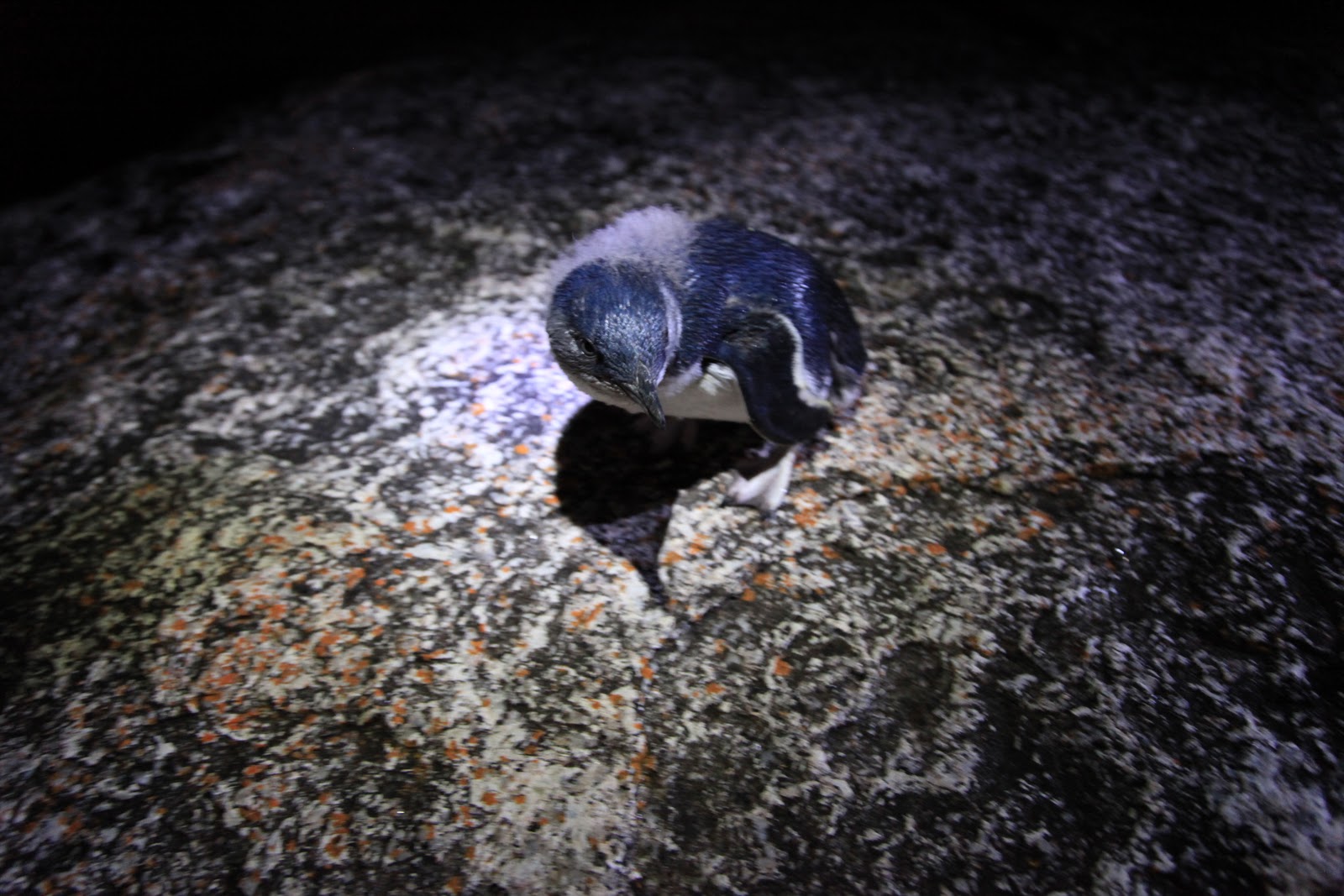
Its rare that you see a sign with the words 'Beware penguins'...but come to the southern hemisphere and its not too uncommon. However, the species of penguin we were interested in here, was the smallest penguin known in the world, the Blue Penguin or Fairy Penguin (Eudyptula minor) and is far from common.


Sporting flashlights and cameras, we headed to the shore at 4am, to a locality that Karen had visited before, for the same reason. Being an avian vet, Karen is inordinately fond of birds, but lets face it, who is not fond of penguins?


Jim, Karen, Victoria, Hillary and I were the only ones to rear our heads at 4am...El decided to sleep it out. As we pulled-up to the beach in my 'soccer-mum' people carrier (a badge I wore for the whole trip!), we were instantly greeting by the calls of waking penguins and the smell of raw/processed fish. When I say processed, I mean via the gut of the said penguins...not a pretty smell. 

As soon as we stepped on to the rocks, we almost stumbled over the Blue Penguins...they were incredibly tolerant of us and our lights, as they hopped and waddled their way to the shore, to make for their feeding grounds.


Some spied us warily from beneath rocks and coves, but most waddled about their morning business.


As the sun began to rise over the shore, fewer and fewer penguins could be seen or heard. The sunrise was suitably tastastic...a great way to start any day.


As we packed up our cameras and headed back to the car, we decided that today would be a wildlife day...besides, it was Boxing day...now what species would be a suitable species to look for on boxing day?


We soon found a sign that confirmed our potential boxing wildlife had undertaken the dangerous past-time of car-tipping...possibly a function of the said species miss-hearing in conversation the unpleasant practice of cow-tipping. Personally, I have no idea why one would want to give spare change to a cow?


Bounding marsupials and spiky monotremes to follow soon!

Wednesday, 5 January 2011

Tasmania....Blighty in disguise!

This has been a slow blog to write, which is certainly no reflection of the time spent in Tasmania...more due to the tortuous flights from Sydney to LA and then Philadelphia. I recall being picked-up at Philadelphia airport, but little else. I seem to have slept for the past two days. I shall now try and observe blogger etiquette and add a day-by-day take on the trip in a few blogs..not one big one as I have in the past.

The team going to Tasmania all met in Sydney Airport. Dr Karen Rosenthal was leading our group, that included myself, Victoria, Jim (Karen's husband) and her two daughters (El and Hillary). We all felt flight fatigued already, but knew we still had a few hours to wait before our connecting flight left for Hobart (Tasmania). We caught a taxi (yes, its too far to walk and there was no other transit) from the international to the domestic terminal. We then sat drinking coffee and eating doughnuts, waiting for the flight. El and Hillary foraged for some local delicacies...Emu Jerky, Crocodile Jerky and Kangaroo Jerky!


The flight to Hobart was short, as most of the team slept. As our plane made its final approach to the Hobart airport, I could not understand why it was heading for such a small strip of road alongside an estuary...until I realised that this was the airport runway! More striking than the optimistic landing area was the likeness of the Tasmanian countryside to that of England. The rolling hills and patchwork of green fields were a complete surprise to me. How could a land so well-known for its biting, stinging, poisonous occupants look so familier.


To say Hobart Airport was small would be an understatement, but to suggest this was a bad thing, would be wrong. The single luggage belt delivered all our luggage and a stuffed seal (as in the marine mammal!), in double-quick time. Unlike Sydney and many other airports where you loose the will to function as your luggage does not arrive, Hobart was a refreshing change.

We soon despatched ourselves to the car hire, where I became nominated driver for the week. This had nothing to do with my skill as a driver, but more to do with the fact that Australians drive on the correct side of the road...i.e. not the right! The lefthand drive and rolling countryside were making me feel quite homesick, but at the same time at home...until I saw my first marsupial roadkill! Large quantities of roadkill became a recurrent theme on the trip...usually accompanied by the words, 'now what was that?'.


We drove through Hobart and then up towards Mount Wellington, a marker I would navigate to and from over the next few days. The winding road took us higher and higher and as we turned off the main highway it soon became a dirt road. After going down hill for only a few hundred yards we turned off onto the 'road' where James and Andrea lived, our hosts for the trip. We wound our way between trees along the track and soon a clearing ahead marked our destination. After being greeted and fed by our hosts, we all collapsed into our beds. I should say that being 'fed' is not doing justice to the wonderful cuisine that Andrea created...as she would each successive night.


We all slept soundly that first night in Tasmania.

Saturday, 1 January 2011

The longest day?

Tomorrow at 12:35pm I set-off for Philadelphia, this being Sunday January 2nd 2011 in Australia...I arrive 20+ hours later in Philadelphia, again on Sunday January 2nd 2011 at 5:30pm in the afternoon. I love the international date-line...it has provided me with the longest January 2nd I have ever had to endure...I say 'endure', as once again I will be flying. My favourite thing :-(

This past week has been stunning. The geology, palaeontology, wildlife and people of Australia have been wonderful. I have to say that Tasmania is a hidden gem, packed with beautiful landscapes, amazing climate and very friendly inhabitants. We all felt welcome and at home.

New Years Eve in Sydney....wow!

Fireworks over the Opera House in Sydney Harbour

Forgive this short blog, as I shall do as I did with China and later provide a longer and more pictorial blog of the past week...but shall write this on my flight to Philadelphia, via Los Angeles. I shall once again disobey the rule of long blogs...my apologies in advance!

Now I must sleep.